
Osceola County Bench Warrants Explained
A bench warrant is really a court-issued arrest order that grows out of an existing case rather than a new accusation. In Osceola County, the usual triggers are missed court dates: an arraignment, a pretrial conference, a trial, sentencing, or some other required appearance. Breaking release conditions works differently. That path can lead to recommitment under Iowa Code chapter 811 instead. The wording on the docket, not the nickname, controls what happens next. Willful failure to appear on a uniform citation follows its own statutory route. Iowa Code section 805.5 makes that failure a simple misdemeanor and directs the court to issue an arrest warrant for the offense itself. The clerk then transfers the order to the issuing agency for enforcement. Calling every such order a capias or capias pro fine is looser than the statute, so stick with Iowa's own phrasing.
Osceola County Bench Warrant Court
Osceola County has no municipal court, justice court, or city warrant clerk of its own. Iowa's Unified Trial Court Act folded those local trial courts into one system. Traffic matters, municipal infractions, misdemeanors, and felonies all get filed in the Iowa District Court, though different judicial officers handle different case levels.
That structure trips people up. A city citation does not send you to a Sibley municipal warrant portal, because none exists. Every local warrant record still routes through the Clerk of the District Court in Osceola County.
How Osceola County Bench Warrants Are Issued
Every Osceola County bench warrant starts with an obligation in a filed case. Miss the event, and the judge or magistrate reviews what happened and may issue an arrest or bench-type order within that officer's authority. A citation failure to appear runs through Iowa Code section 805.5, while a release-condition violation may instead trigger recommitment or a new custody decision under chapter 811. The flow is predictable. A required event comes first, then the missed appearance or violation, judicial review, the warrant or order, a docket entry by the clerk, transfer or service by an authorized agency, and finally arrest or voluntary appearance. Afterward the court can revisit bond, return the order, recall or quash it, accept payment, reschedule, or dispose of the case. An Osceola County warrant does not expire with age alone. Only later court action clears it.
Osceola County Bench Warrant FTA Chain
The citation itself sets the stage. It lists the appearance date, the place, and the underlying offense. A willful failure to appear makes section 805.5 apply, which means a simple-misdemeanor FTA offense and an arrest warrant. The Osceola County clerk receives the warrant and sends it to the issuing agency. After an arrest, both the warrant and the citation go back to court.
- Search Iowa Courts Online by citation number, case number, or exact name.
- Read the events for the missed appearance, warrant issuance, service, bond, or later order.
- Call the clerk to ask whether the FTA created a new event or case and what appearance is required.
- Ask whether payment alone is enough or whether the judge must recall the warrant.
New citations take 10 to 14 days to post. So a fresh Osceola County paper citation can exist before the public search shows the case at all.
Bench Warrants and Arrest Warrants Compared
Both types authorize custody, but they arise for different reasons. Look at the underlying event and the order itself, not the casual label, to see which Osceola County path applies.
| Feature | Bench warrant | Arrest warrant |
|---|---|---|
| Main trigger | Missed event or failure to obey a court order | Probable cause or formal charging event |
| Case setting | Usually an existing case | May begin or advance a charged case |
| Iowa wording | Bench order, FTA warrant, arrest warrant, or recommitment | Arrest warrant under chapter 804 or court rule |
| Next question | What appearance, reset, recall, payment, or filing applies? | What surrender, bond, and first-appearance process applies? |
| Who confirms | Clerk for docket, sheriff for service | Clerk for order, sheriff for service |
A bench warrant is not automatically a new criminal charge. A citation FTA in Osceola County is the exception, since section 805.5 creates a separate simple-misdemeanor offense.
Osceola County Bench Warrant Clerk
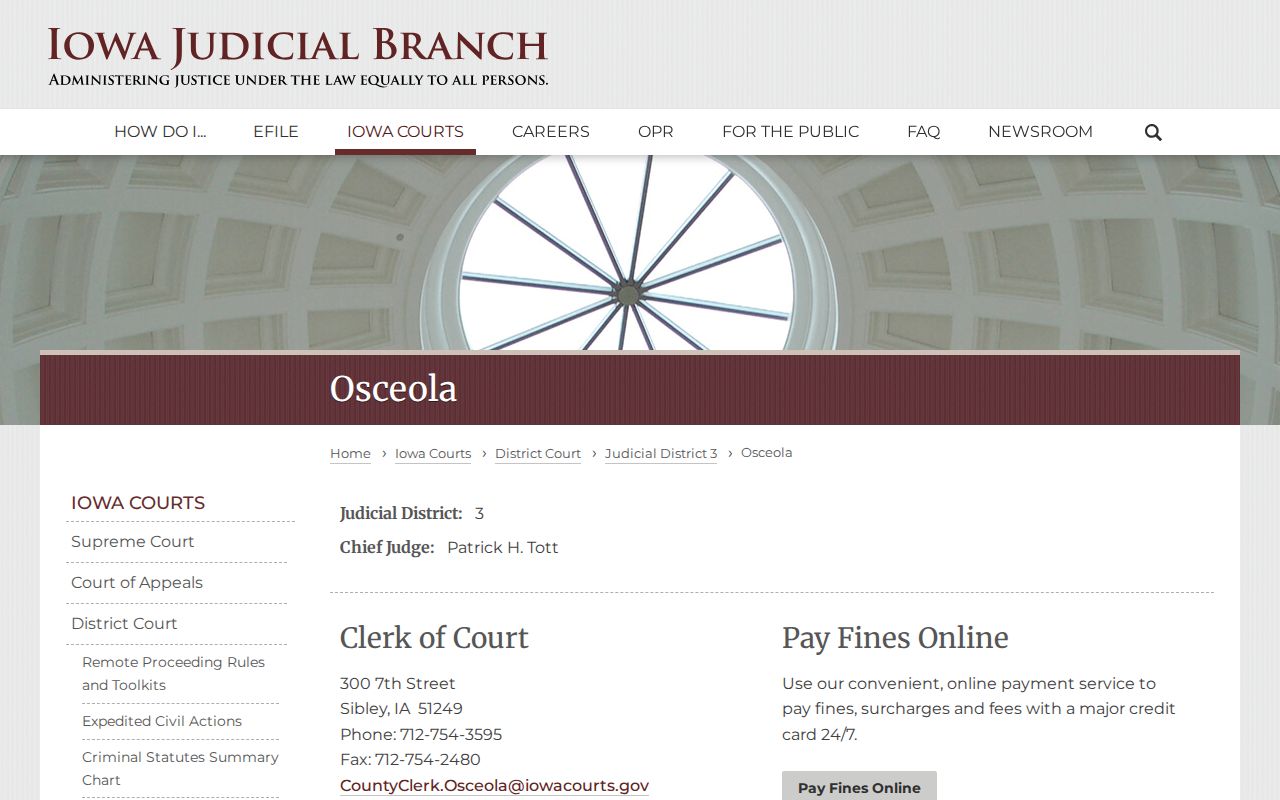
The Clerk of the District Court, Osceola County sits at 300 7th Street in Sibley. Call 712-754-3595 with the case or citation number. Ask which event created the warrant, whether a hearing is set, whether a motion or appearance is required, and whether bond or release terms appear in the record. The official District 3 court page shows the clerk contact and access route.
Court staff explain filing steps and public access. They cannot choose your legal remedy for you. An Osceola County lawyer can assess a reset, recall, quash, voluntary appearance, bond request, or defense.
Resolving an Osceola County Bench Warrant
Osceola County publishes no walk-in warrant window, generic recall form, recall fee, bond schedule, or bond-window hours. The right sequence depends on the current court order.
- Confirm the warrant and case through the public docket and clerk.
- Ask what hearing, motion, appearance, payment, or reset applies.
- Contact a lawyer when possible; do not try to contact the judge privately.
- Call the sheriff at 712-754-2556 before reporting for service or surrender.
- Ask about current intake, identification, bond, and magistrate-review instructions.
- Keep the filed order, receipt, bond paper, or other proof after action.
Do not ignore it: A confirmed bench warrant can lead to arrest during a later lawful contact.
Paying may satisfy the court debt without recalling the warrant. A restored driver's license proves nothing about recall either. Ask the Osceola County clerk what separate order is required.
Osceola County Bench Warrant Recommitment
Violating release conditions is not the same as missing a citation date. Iowa Code chapter 811 covers personal recognizance, unsecured appearance bond, cash or surety arrangements, forfeiture, surrender, and recommitment. The Osceola County court may review release after any failure to appear or violation.
- FTA warrant
- An arrest warrant tied to failure to attend a required event.
- Recommitment
- A custody order tied to release terms or a return-to-custody duty.
- Recall
- A later court action withdrawing the warrant.
- Quash
- A court order setting the warrant aside.
- Bond
- Security for appearance, not a decision on the underlying case.
Osceola County posts no bond schedule or online bond processor. Ask the clerk or sheriff for current, case-specific instructions.
Finding the Court That Issued the Warrant
The Iowa District Court issued the local order, but which judicial officer signed it still matters. A district judge holds general jurisdiction, including felonies and major proceedings. A district associate judge hears assigned serious or aggravated misdemeanors, class D felonies, and other matters. A judicial magistrate handles simple misdemeanors, scheduled violations, county and municipal infractions, preliminary matters, and other authorized work.
| District Court clerk | Docket, filed order, public terminal, case routing, and procedure. |
|---|---|
| District judge | General jurisdiction and many felony, sentencing, release, or bench orders. |
| Associate judge | Assigned misdemeanor, class D felony, and other authorized cases. |
| Judicial magistrate | Scheduled violations, simple misdemeanors, infractions, and preliminary work. |
| Sheriff | Service, custody, reporting, and intake questions, not recall authority. |
The Osceola County clerk, not any municipal counter, identifies which case and judicial officer control the next step.
Confirm Osceola County Bench Warrant Updates
Any step that touches a bench warrant needs a paper trail. After you appear, pay, post bond, surrender, or get a recall or quash order, ask the clerk when the docket will change. Save the case number and your proof. Then ask the Osceola County sheriff whether its service record has caught up too. The public docket can lag behind. Clearing the warrant also does not dismiss the underlying charge or end every court duty. If a public order is not available remotely, the Judicial Branch records policy explains your options, and a courthouse terminal may provide access, though unexecuted arrest warrants, juvenile files, sealed matters, and protected investigative information may remain restricted.
Scam check: Iowa courts do not demand money by text or phone, and law enforcement does not collect court fines.
Call the Osceola County clerk or sheriff yourself, using contact information you look up independently. Never pay by prepaid card or cryptocurrency to avoid an arrest threat.